
From Struggles to Stardom: The Journey of Indian Women’s Cricket
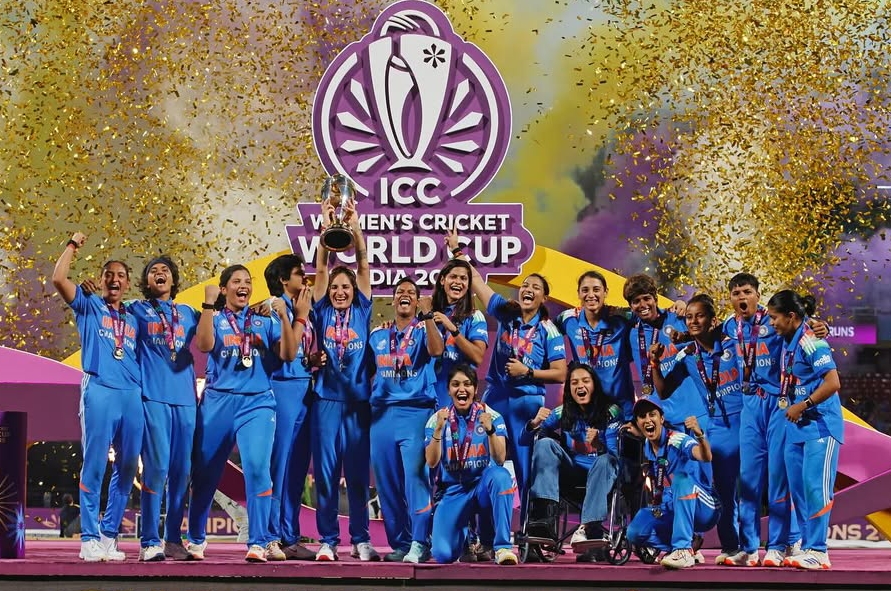
(used for editorial purposes only).
When Harmanpreet Kaur’s team lifted the ICC Women’s World Cup trophy at the DY Patil Stadium in Navi Mumbai, the roar wasn’t just for a victory — it was for every woman who once played cricket in silence.India’s maiden Women’s World Cup title in 2025 marked not only the team’s arrival at the top but also the culmination of a decades-long struggle for recognition, respect, and resources.
When No One Was Watching
In their early years, the Indian women’s cricket team faced immense struggles — a chronic lack of funding, poor infrastructure, non-existent professional support, and widespread societal bias.Cricket was not considered a sport for women, and those who pursued it did so out of pure passion, often without the backing of family or society.
Minimal Financial Support: The sport was run on a shoestring budget by the Women’s Cricket Association of India (WCAI) before the BCCI took over in 2006. Players had no annual contracts, and match fees were almost symbolic. Even after reaching the 2005 World Cup final, the squad received just ₹1,000 per match — a figure that underlined how little value was attached to their efforts.
Inadequate Facilities and Equipment: Players frequently shared basic gear, sometimes rotating a single bat among several teammates. Quality pitches, nets, or fitness facilities were rare, especially in smaller towns. Even at official venues, proper changing rooms and toilets for women were often missing.
Difficult Travel and Accommodation: The team’s travel arrangements reflected the harsh reality of a sport running on limited means. In the early years, Indian women cricketers often traveled in unreserved compartments of trains for 36 to 48 hours, covering their own fares from personal savings. The WCAI, which managed the sport before the BCCI’s takeover, struggled to fund even basic logistics.For international tours, finding sponsors was so difficult that players sometimes depended on external donations — even a celebrity’s ad fee — to afford air tickets.
They carried their own heavy cricket gear and bedding, hauling kit bags through stations and onto buses without professional support staff. Accommodation was typically basic — school dormitories, marriage halls, or modest guesthouses — often with limited or unhygienic facilities, such as four toilets for twenty players and no attached bathrooms. Safety during travel was also a genuine concern. Many players journeyed alone or used public transport for domestic matches and practice sessions, making families understandably anxious about sending their daughters into such uncertain conditions.
Lack of Recognition and Media Attention: For decades, women’s cricket existed largely outside the public eye. Matches went untelevised, sponsorships were absent, and the media offered only passing mentions. Players played not for money or fame, but for the pride of representing India.
Societal and Cultural Barriers: Many players faced skepticism at home. Parents urged them to focus on studies or marriage instead of sport. The idea that cricket could be a profession for women was almost unthinkable.
Still, Indian women’s cricket was kept alive by a handful of passionate trailblazers who refused to give up. Diana Edulji, Shantha Rangaswamy, Shubhangi Kulkarni, Sandhya Agarwal, Sudha Shah, and others laid the foundation brick by brick — often without pay, recognition, or even basic facilities.They took the field in stitched jerseys and unbranded kits, playing purely for the love of the game.
The Foundation of Hope
Their efforts slowly carved a space for women’s cricket in a male-dominated sporting world, but visibility remained painfully low. By the late 1990s, the sport needed not just participants but icons — players who could inspire a generation.
That’s when players like Mithali Raj and Jhulan Goswami emerged — two names that became synonymous with excellence and discipline. Mithali’s calm dominance with the bat and Jhulan’s fiery pace gave Indian women’s cricket credibility on the world stage.Their rise coincided with the BCCI’s takeover of women’s cricket in 2006, which brought a sense of structure and long-awaited relief. Players now had proper kits, better travel arrangements, and modest allowances — small but meaningful changes after years of neglect.
However, progress was far from complete. Women’s cricket still lacked world-class infrastructure, and a strong domestic system to nurture young talents. Training facilities remained limited, and scouting for young talent was largely unorganised. Even with stars like Mithali and Jhulan carrying the team, the absence of a strong foundation continued to affect India’s performances.
India struggled to build consistency and depth. Their campaigns in major tournaments — including the 2012 T20 World Cup in Sri Lanka, 2013 ODI World Cup at home, 2014 T20 World Cup in Bangladesh, and 2016 T20 World Cup again on home soil — all ended in disappointment.Without strong domestic competition or international exposure, the team often relied on individual brilliance rather than collective strength.
The Turning Point
By the time the 2017 ICC Women’s World Cup arrived, expectations were modest at best. The media barely followed the team, and most fans didn’t even know when their matches were being played.But quietly, something began to shift. The Indian team played with renewed belief, advancing steadily through the tournament and defying the odds to reach the semifinals — where they faced the mighty Australia, the tournament favourites and defending champions.
What followed became one of the defining moments in Indian sporting history. On that day, Harmanpreet Kaur produced an innings for the ages — an unbeaten 171 off 115 balls that stunned Australia and electrified the cricketing world.India’s victory wasn’t just an upset; it was a statement — a declaration that women’s cricket in India was ready to stand shoulder to shoulder with the best.
In the final at Lord’s, the team’s remarkable run — highlighted by Harmanpreet’s heroics — made the nation take notice. For the first time, India tuned in to watch its women cricketers with the same passion reserved for the men’s side.However, despite dominating for much of the match, India fell agonisingly short against England, losing by just nine runs. But that near miss at Lord’s became a catalyst — proof that India was capable of greatness; all that was missing was consistent backing.
The Evolution of women’s cricket
In the years that followed, BCCI’s support deepened. Central contracts were formalized, coaching standards rose, and the Women’s Premier League (WPL) was launched — giving domestic players the exposure and financial stability they had long been denied.Facilities improved, sponsorships increased, and the visibility of women’s cricket expanded rapidly.This transformation wasn’t just administrative — it changed how players trained, thought, and competed. The new generation grew up believing they could win world titles, not merely participate in them.
A New Generation, A New Standard
By the time of the 2025 World Cup, India’s women’s team was no longer the underdog. The squad combined the calm experience of Harmanpreet Kaur and Smriti Mandhana with the fearless energy of Pratika Rawal, Deepti Sharma, and Richa Ghosh.Their preparation was methodical, their mindset steeled by years of near misses.Throughout the tournament, India displayed balance — aggression up front, depth in batting, and discipline in bowling. Shafali Verma’s explosive 87 in the final against South Africa set the tone, while Deepti Sharma’s all-round brilliance sealed the match.India’s 52-run victory wasn’t just convincing; it was symbolic of how far the team had come.
Beyond the Trophy
As the tricolour waved and chants of “India! India!” echoed across the nation, the moment felt larger than sport. It was the reward for generations who had played without applause, who had trained without facilities, and who had dreamed without guarantees.
For Indian women’s cricket, this wasn’t just a world title — it was closure and a new beginning all at once.The impact of this triumph extends far beyond the boundary. Young girls across India now have visible heroes to look up to — players who have proved that talent, when supported, can rewrite history.
The BCCI’s ₹51-crore reward for the squad underlines how far recognition has come.For decades, Indian women’s cricket survived on grit and self-belief. Today, it stands as a global powerhouse — backed by infrastructure, investment, and a passionate following.
The journey from borrowed pitches to packed stadiums is complete — and yet, it’s only the start of a new era.